Legend says travellers once carried garnet as a lamp for the dark road, a stone to keep them steady and bring them safely home. Its name comes from the Latin granatum, pomegranate, after the fruit’s glowing red seeds, and its Chinese name, 石榴石 (shíliú shí), means “pomegranate stone” too. Garnet is not one mineral but a family, and although deep red is its classic colour, garnets also come in orange, green and purple.
Garnets were strung into necklaces in ancient Egypt, inlaid by Anglo-Saxon goldsmiths and loved by Victorian jewellers. In birthstone tradition, January’s stone stands for protection and strength; in crystal lore it is also a stone of love, devotion and courage.
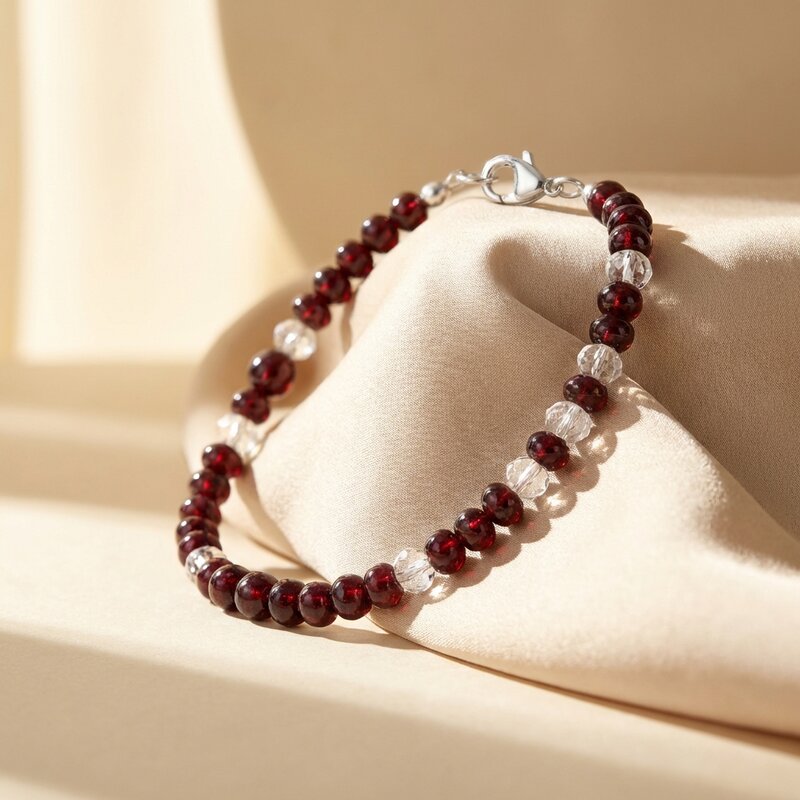
A garnet gift says “keep going, and come home safe”: a warm choice for a January birthday, a friend setting off on a journey, or a partner at the start of the year. Explore our garnet guide; a garnet necklace with clear quartz beads makes a lovely keepsake.
Care: Wash in warm, soapy water with a soft brush and dry well. Avoid sudden temperature changes, and store garnet apart from softer pieces, which it can scratch.
The garnet guide
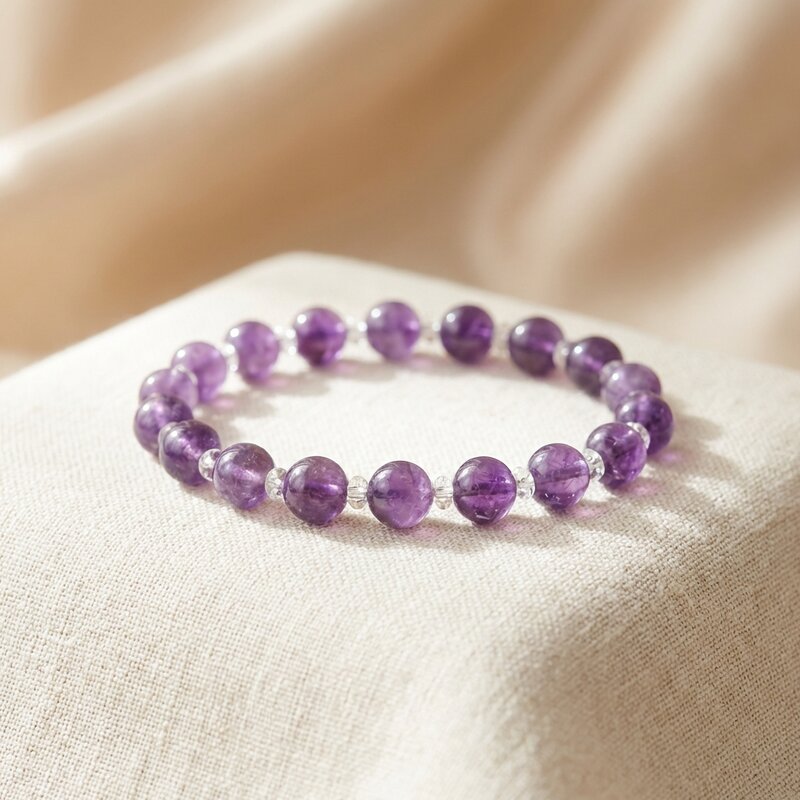
The ancient Greeks named amethyst amethystos, “not intoxicated”, believing it kept the wearer clear-headed, and it has been the stone of a clear head and a quiet, sovereign mind ever since. It is the purple variety of quartz, ranging from pale lilac to deep violet. For centuries it ranked among the most precious gems, worn by bishops and royalty, until large deposits in Brazil made it widely available in the nineteenth century.
In birthstone tradition, February’s stone stands for wisdom and stability. Crystal lore adds calm, balance, patience and peace, and amethyst is a favourite companion for meditation. In Chinese it is 紫水晶 (zǐ shuǐjīng), and amethyst clusters and geodes are popular in feng shui.
Amethyst makes a gentle, steadying gift: for a February birthday, a student before exams, or anyone in a busy season. See our amethyst guide; a simple strand of amethyst beads is an easy first piece.
Care: Clean with warm, soapy water and a soft brush. Keep amethyst out of strong, prolonged sunlight and heat, which can fade its purple.
The amethyst guide
Sailors wore aquamarine for calm seas and safe passage. Its name is Latin for “water of the sea”, and in ancient lore it was the treasure of mermaids. It is the colour of water where the light reaches all the way down, a clear pale blue to blue-green that comes from traces of iron. Aquamarine belongs to the beryl family, making it a sister of emerald, and it often grows in long, clean crystals, which is why it can be cut into large stones of remarkable clarity.
In birthstone tradition, March’s stone stands for serenity and clarity. Crystal lore adds truth, trust and letting go, and aquamarine is traditionally worn as a necklace, over the throat chakra, for calm and honest speech. In Chinese it is 海蓝宝 (hǎi lán bǎo), “sea-blue treasure”.
Aquamarine is a lovely gift for a March birthday, for a friend who loves the sea, or for someone facing a big conversation. Read our aquamarine guide.
Care: Wash in warm, soapy water and dry with a soft cloth. Aquamarine is durable, but avoid hard knocks and sudden temperature changes.
The aquamarine guide
Diamond takes its name from the Greek adamas, “unconquerable”: light made permanent, and the stone of promises kept. It is pure carbon, crystallised deep within the earth under immense heat and pressure, and it is the hardest natural mineral known. Its famous fire comes from its strong dispersion, which splits white light into flashes of colour.
For most of history, India was the world’s only significant source of diamonds, until finds in Brazil in the eighteenth century. In 1477 Archduke Maximilian of Austria gave Mary of Burgundy a diamond ring for their betrothal, one of the earliest recorded diamond engagement rings. In birthstone tradition, April’s stone stands for eternity and love, and it has long been linked with strength and clarity.
A diamond is the classic gift for an April birthday or a milestone anniversary. Some modern birthstone lists, including the British one, also offer rock crystal for April: clear quartz, a gentle and affordable alternative that crystal lore calls an amplifier of intention.
Care: Soak in warm, soapy water and brush gently, as diamonds attract grease. Despite its hardness, a sharp knock can chip a diamond, so store it apart from other jewellery.
Emerald is spring held still, the green of renewal. Like aquamarine it is a beryl, coloured an intense green by traces of chromium or vanadium. Almost every emerald has inclusions, which jewellers affectionately call its jardin, or garden; a completely clean emerald is extremely rare.
Cleopatra famously loved emeralds, and the Roman writer Pliny declared that nothing is greener, noting that gem engravers rested their eyes on its soft colour. The finest emeralds have come from Colombia for centuries, and they are also found in Zambia and Brazil. In birthstone tradition, May’s stone stands for hope and renewal, and it has long been said to steady the heart and to symbolise faithful love.
Emerald is a meaningful gift for a May birthday, a new beginning or a fifty-fifth wedding anniversary. For an everyday touch of May green, crystal lovers often turn to green aventurine, a quartz with its own traditions of luck and growth.
Care: Wipe with a soft cloth and lukewarm, soapy water. Most emeralds are oiled to improve clarity, so avoid ultrasonic and steam cleaners, heat and solvents.
Moonstone holds a light that moves within it, as moonlight moves on water. That glow, called adularescence, comes from thin alternating layers of two feldspar minerals inside the stone, which scatter light as you turn it. The Romans believed moonstone was formed from moonlight itself, and in India it has long been considered sacred and a traditional gift between lovers.
June is one of the few months with two birthstones. Pearl, the other, is an organic gem grown by oysters and mussels, and it has stood for purity and wisdom since antiquity. Together they give the month its virtues of purity and intuition. In crystal lore, moonstone is a stone of inner growth, new beginnings and emotional calm, often given to reunite lovers.
For a June birthday, moonstone suits someone starting something new, and pearl suits a milestone. Read our moonstone guide.
Care: Moonstone can chip along its cleavage, so avoid knocks and clean it with mild soapy water, never ultrasonic or steam. Pearls are soft: put them on after perfume and hairspray, and wipe them with a soft cloth after wearing.
The moonstone guide
In Sanskrit, ruby is ratnaraj, “king of gems”: a living ember, worn for courage, love and vitality. It is the red variety of corundum, the same mineral as sapphire, and its colour comes from chromium. That chromium also makes ruby glow red under ultraviolet light, one reason the finest stones seem lit from within; the most prized shade is known in the trade as “pigeon’s blood”.
For centuries the most celebrated rubies came from the Mogok valley in Myanmar, and rubies are also found in Thailand, Sri Lanka and Mozambique. In birthstone tradition, July’s stone stands for vitality and passion; in old lore it was also a stone of protection for its wearer.
A ruby is a classic gift for a July birthday or a fortieth wedding anniversary. For something more everyday, carnelian, July’s alternative in the British birthstone list, and garnet share its warm red in crystal lore.
Care: Ruby is very durable; clean it with warm, soapy water and a soft brush. If a ruby has been glass-filled, as many are, avoid harsh chemicals, heat and ultrasonic cleaners.
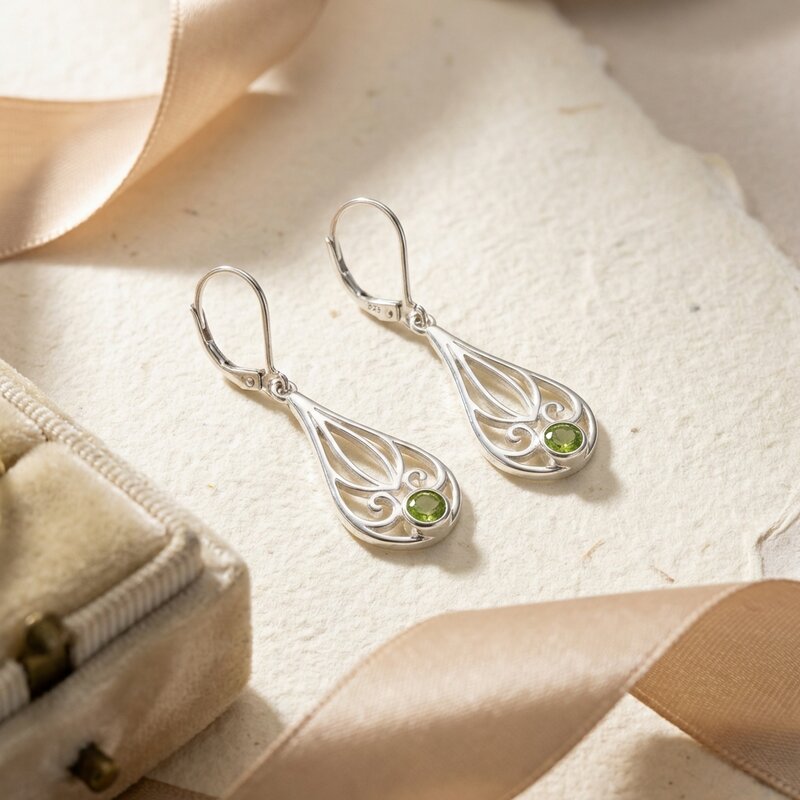
Peridot is born deep in the earth and carried up by fire. It is the gem form of olivine, a mineral of the earth’s mantle brought to the surface by volcanic activity, and it has even been found in meteorites. Its fresh green, from iron, is the only colour it comes in, in shades from lime to olive. The ancient Egyptians mined it on an island in the Red Sea and are said to have called it the “gem of the sun”; in Hawaiian legend, peridot sand is the tears of the volcano goddess Pele.
In birthstone tradition, August’s stone stands for beauty and delight. Old lore said it chased away the fears of the night, and in crystal practice it is the stone of compassion, believed to bring peace to relationships by balancing emotions and mind. In Chinese it is 橄榄石 (gǎnlǎn shí), “olive stone”.
For an August birthday, peridot is a bright, optimistic gift, and its green looks especially fresh against 925 silver. See our guide to silver gemstone earrings.
Care: Clean with warm, soapy water and a soft cloth. Peridot is sensitive to acids and sudden temperature changes, so avoid steam and ultrasonic cleaners.
Sapphire has long been the stone of vows: the blue of a clear night, and of a word you can trust. Like ruby it is corundum, surpassed in hardness among gems only by diamond, and it owes its blue to traces of iron and titanium. Sapphire also occurs in pink, yellow, green and almost every other colour except red, which is ruby.
Medieval clergy wore sapphire to symbolise heaven, and kings wore it for wisdom and protection. Fine blue sapphires have come from Kashmir, Myanmar and Sri Lanka, and today also from Madagascar. The best-known sapphire of recent times is the engagement ring given to Diana, Princess of Wales, and now worn by Catherine, Princess of Wales. In birthstone tradition, September’s stone stands for truth and sincerity.
Sapphire is a meaningful gift for a September birthday, an engagement or a forty-fifth wedding anniversary. In crystal lore, lapis lazuli, September’s alternative in the British list, shares its royal blue and its link with wisdom.
Care: Sapphire is very durable; clean it with warm, soapy water and a soft brush. Store it apart from softer gems, which it can scratch.
The Romans called opal the queen of gems, for it holds every colour at once, and no two flashes are ever the same. That play of colour comes from tiny spheres of silica stacked inside the stone, which diffract light into flashes of spectral colour. Opal also holds water within its structure, which is why it needs gentle care. Most of the world’s precious opal comes from Australia.
Opal’s undeserved reputation for bad luck traces largely to a novel by Sir Walter Scott published in 1829; Queen Victoria, who loved opals, helped restore its name. October’s second stone, tourmaline, comes in more colours than almost any other gem, and its name is said to come from a Sinhalese word for mixed stones. In birthstone tradition, the month stands for creativity and hope.
For an October birthday, opal suits an artist or a dreamer, and tourmaline suits someone who loves colour. Pink opal, a gentle common opal, is known in crystal lore as the “Stone of Resolution”.
Care: Opal is soft and contains water: avoid heat, sudden temperature changes, ultrasonic cleaners and long soaks, and wipe it with a soft, damp cloth. Tourmaline is tougher and can be washed in warm, soapy water.
Golden topaz was said to hold the warmth of the sun: a stone of generosity, and of fortune that arrives gently. Its name is often traced to Topazios, an island in the Red Sea described by Roman writers, though the gems found there were probably peridot. Pure topaz is colourless; the golden, sherry and rare pinkish-orange “imperial” shades are the ones traditionally tied to November, and most bright blue topaz on the market has been treated.
November’s second stone, citrine, is the golden variety of quartz, named from the French citron. Natural citrine is rare, and much of what is sold has been heat-treated from amethyst. In crystal lore it is often called the “Success Stone”, bringing energies of generosity and manifestation. In birthstone tradition, the month stands for joy and fortune.
For a November birthday, both make warm, sunny gifts. Explore our citrine guide; a bracelet that pairs citrine with soft pink quartz is a cheerful way to wear it.
Care: Topaz is hard but splits easily along its cleavage, so avoid knocks, steam and ultrasonic cleaners, and wash it in warm, soapy water. Citrine can fade in strong, prolonged sunlight.
The topaz guide
One of the oldest talismans on earth, turquoise is a piece of sky to carry, for friendship, luck and safe journeys. Egyptians mined it in Sinai some five thousand years ago, Persian turquoise was prized for centuries for its pure sky blue, and it is still cherished in Tibetan and Native American traditions. Its name comes from the French for “Turkish stone”, after the trade routes that carried it to Europe.
Turquoise is a copper-bearing phosphate: copper gives the blue, and iron shifts it towards green. Veins of the host rock, called matrix, run through many stones. Old lore held that turquoise changed colour to warn its wearer of danger; in practice it is porous and can darken as it absorbs oils. In birthstone tradition, December’s stone stands for friendship and luck, and in crystal lore it is a stone of protection and purification. In Chinese it is 绿松石 (lǜsōng shí).
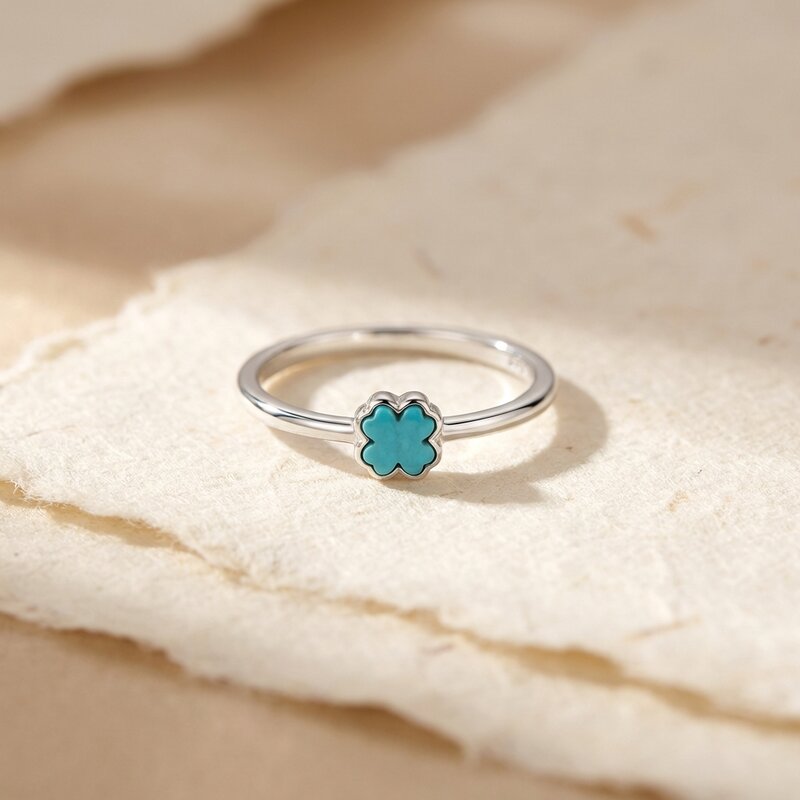
Turquoise is a thoughtful December gift, especially for a traveller, and a turquoise ring or pendant adds a traditional symbol of luck. See our guide to gemstone rings.
Care: Turquoise is soft and porous: keep it away from water, perfume, lotion and cleaning products, and wipe it with a soft, dry cloth. Put it on last and take it off first.