
Two stones called jade
In Chinese, 玉 (yù) has meant precious stone for thousands of years. In gemmology, though, “jade” is a name shared by two quite different minerals, and knowing which one you are looking at is the first step to buying well.
Jadeite, 翡翠 (fěicuì), is a pyroxene: a sodium aluminium silicate made of tightly interlocking crystals. It measures about 6.5 to 7 on the Mohs scale and takes a bright, glassy polish. Myanmar is by far the most important source of gem-quality jadeite, and its most prized colour, a vivid “imperial” green, comes from traces of chromium.
Nephrite is an amphibole, from the tremolite–actinolite series, made of densely matted fibres. It is a little softer, around 6 to 6.5, but exceptionally tough: that felted structure resists breaking better than almost any other gem material, which is why ancient carvers could work it so finely. Its colours run from creamy “mutton fat” white through celadon to deep spinach green. The most celebrated Chinese nephrite is Hetian jade, 和田玉 (Hétián yù), from Xinjiang; nephrite is also found in Canada, Russia and New Zealand, among other places.
Neither is simply “better”. Nephrite is the jade of ancient China, carved into ritual discs and ornaments since Neolithic times. Jadeite arrived in quantity from Burma only in the Qing dynasty, around the eighteenth century, and has led the jewellery market ever since.
Type A, B and C: the words that matter most
With jadeite in particular, the most important question about a piece is not its colour but whether it has been treated. The trade uses a simple shorthand:
- Type A — natural jadeite, untreated apart from the traditional light surface waxing that finishes the polish. This is what families mean when they speak of heirloom jade.
- Type B — jadeite that has been bleached with acid to remove brownish staining, then impregnated with polymer resin to fill the weakened structure and improve clarity. It can look lovely at first, but the resin may yellow or cloud over the years, and the stone is left more fragile.
- Type C — jadeite that has been dyed to improve or change its colour, often to green or lavender. Dyed colour can fade with time and light.
- Type B+C — bleached, impregnated and dyed.
Treated jade is not a scandal in itself, provided it is sold as what it is and priced accordingly. The problem is treated jade sold as natural. A Type B bangle and a Type A bangle can look almost identical across a counter, while the difference in value can be very large.
Why the tap, touch and scratch tests don’t work
Every jade buyer has been shown a trick or two. None of them is reliable.
- The tap test. The idea is that real jade rings when tapped and imitations sound dull. In practice the sound depends on the shape and thickness of the piece and on any hidden cracks, and resin-filled jade and some imitations can ring convincingly too. Tapping also risks damaging a good bangle.
- The cold touch. Jade does feel cool, but so do quartz, glass and most other stones. Temperature tells you almost nothing.
- The scratch test. Jadeite is close to quartz in hardness, so a scratch cannot tell it apart from dyed quartzite, a common imitation — and it can leave a permanent mark on a genuine piece.
Treatments are especially hard to see by eye: detecting the polymer in Type B jade usually needs infrared spectroscopy and other instruments in a gemmological laboratory. Imitations are just as varied. Green aventurine quartz (sometimes sold as “Indian jade”), serpentine (“new jade”), dyed quartzite (“Malaysia jade”) and glass all turn up under the name. Aventurine is a lovely stone in its own right — read about green aventurine — but it is not jade.
How to buy jade with confidence
- Ask directly about treatment. “Is this Type A?” is a normal question in any jade shop. A reputable seller will answer plainly and put the answer in writing on your receipt.
- Get a lab report for significant purchases. For an important bangle or pendant, ask for — or arrange — a report from an independent gemmological laboratory stating the material (jadeite or nephrite) and whether it is natural or treated. A certificate written by the selling shop itself is not the same thing.
- Look in daylight. Shop lighting flatters green. Step towards a window if you can.
- Buy what you love. Jade is usually worn for decades. A piece whose colour and feel delight you is worth more to you than a higher grade you feel lukewarm about.
Colour, water and texture
Once you know what a piece is, its quality comes down to three things. Colour first: in jadeite, an even, vivid, saturated green is the most prized, but lavender, white, yellow and the reddish tones traditionally called 翡 (fěi), as opposed to green 翠 (cuì), all have their admirers. Evenness matters as much as depth; blotchy colour is valued less, though gentle natural veining can be charming.
Water, 水头 (shuǐtóu), is the trade’s word for translucency: how deeply light seems to travel into the stone. The finest jadeite glows almost like glass, and the clearest grades are called “glass type”, 玻璃种 (bōli zhǒng), followed by “ice type”, 冰种 (bīng zhǒng). Texture is the fineness of the grain. Hold a piece to the light: fine-grained jade looks smooth and even, while coarse jade shows visible granules. Finer texture takes a better polish and generally commands a higher price.
Bangles, rings and jade in Singapore life
A jade bangle is solid, with no clasp, so it has to slide over the widest part of your hand. Bangles are sized by inner diameter, and a jeweller will usually measure around your knuckles with your thumb and little finger drawn together, as they will be when the bangle goes on. Profiles vary — round, oval and flat on the inside — and a flatter inner edge sits more comfortably against the wrist. Try before you commit: a bangle that is too tight is hard to remove, and one that is too loose is easily knocked.
In Singapore, jade still marks the big moments of Chinese family life: a bangle passed from mother to daughter or given to a bride, a small pendant for a newborn, a Ping An Kou 平安扣 disc for safety. An old saying holds that 黄金有价玉无价 — gold has a price, jade is priceless — and in Confucian thought jade stood for the virtues of a gentleman. Our Jade & Zodiac guide explains the guardian deities, carving motifs and the jade colours traditionally matched to each sign.
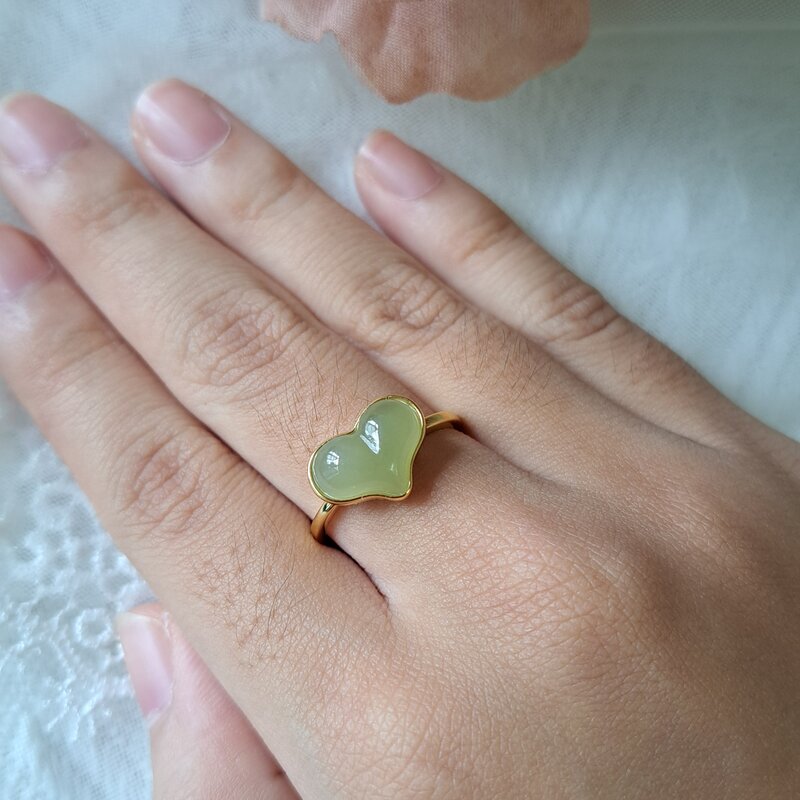
For everyday jade, a ring or a pendant is an easy way to begin. Join us live on Instagram or TikTok to see pieces up close and ask questions, or message us on WhatsApp before you buy. Our guide to jade jewellery covers choosing and wearing a jade ring.
Caring for jade
Jade is tough, but not unbreakable: a bangle dropped on a tiled floor can crack. Take it off for sport and heavy chores, wipe it with a soft, damp cloth, and keep it away from harsh chemicals, strong heat and ultrasonic cleaners, which can damage resin-filled jade. Store it apart from harder gems and metal pieces so it keeps its polish.
In Chinese folklore, a jade piece that breaks without cause is said to have taken a blow meant for its wearer — one more reason jade is treasured as a guardian as much as an ornament.
Crystal meanings and feng shui are shared from tradition for reflection and enjoyment; they are not a substitute for medical, financial or professional advice.